
Multi‑variable statistical tests
Going beyond binary comparisons
Analyzing high-dimensional mass cytometry (CyTOF) data is complex and often time-consuming. Comparing markers across several patient groups can be especially demanding, both to identify what to test and to find results that are statistically significant.
CyTOF analyses are frequently framed around binary outcomes (for example, responder vs. non-responder). But when additional metadata is available, it is often just as valuable to explore differences across multiple subgroups, such as smoking status, dose levels, or other cohort attributes.
Even when these relationships are scientifically important, it can take substantial time to decide where to look and to run the right statistical tests, particularly when the comparison involves more than two groups.
Multi-group comparisons in Cytofit
Cytofit’s multi-variable statistical testing is built directly on feedback from our pilot users. The feature lets you attach richer metadata to each patient, beyond binary responses, and then run an ANOVA test to compare selected features across multiple groups.
With the multi-variable feature, you can define the groups you want to compare using your existing cohort metadata. Then you select the cell populations you want to compare and run the test in one workflow.
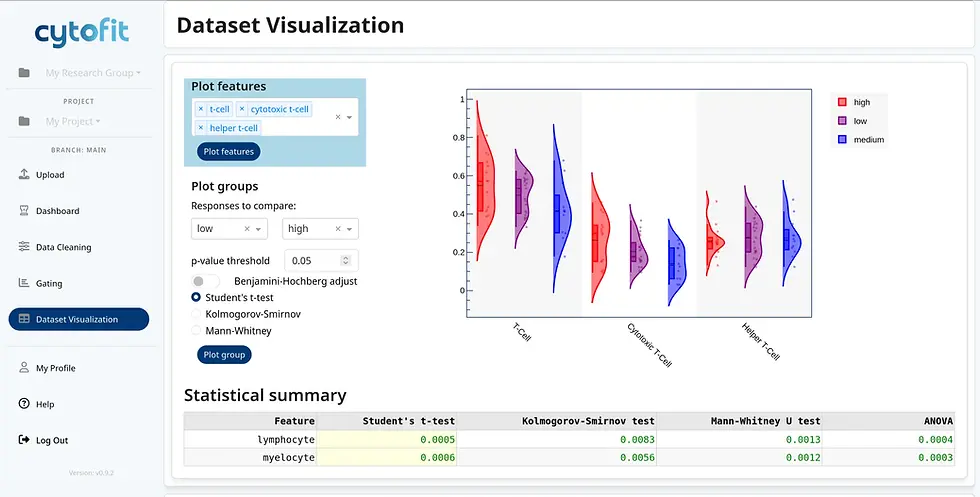
The result is a clear overview that highlights if they are statistically significant differences across the groups. From there, it is easier to decide what deserves a deeper biological interpretation.
In simple terms, you can run a mult-variable test on the features you care about and and quickly get an overview of where statistically significant relationships appear.
Fast multi-group significance
For Cytofit users, this means faster insight when comparing multiple groups in the dataset.
You can quickly identify where the data shows statistically significant differences, adjust thresholds such as p-values, and move to follow-up analyses with confidence.
This also helps teams standardize how they test multi-group hypotheses, making results easier to reproduce across projects and collaborators.
If you’d like to learn more, we’d be happy to walk you through the feature in a demo.


Comments