
The Cytofit Story – From User Need to Cloud Platform
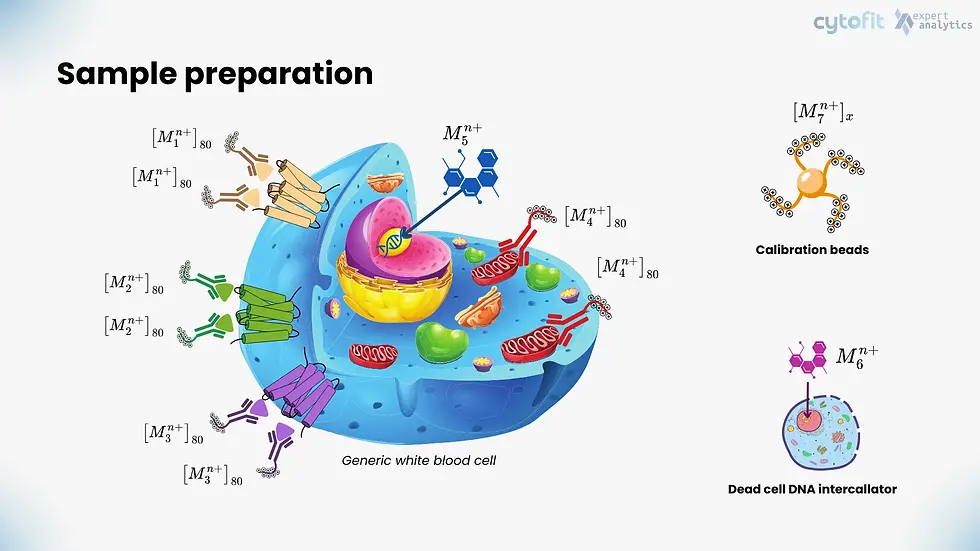
Cytofit started with a concrete problem: cancer immunotherapy researchers analyzing patient cell samples with mass cytometry(CyTOF) were generating rich and complex datasets, but turning those data into insights was time-consuming, fragmented, and technically demanding. Traditional analysis workflows relied on a patchwork of complicated software tools, scripts, manual gating and subjective decision making. Time from data availability to meaningful results was often measured in weeks.
Cytofit was created to change that.
User-driven innovation at its core
Since its beginnings as a pro bono project, Cytofit has been shaped by close collaboration with domain experts in mass cytometry and cell therapy connected to Oslo Cancer Cluster. Cytofit’s foundational goal was to empower researchers to create and run customized statistical workflows for their mass cytometry projects in a simple, reproducible way.
Early development focused on real analysis workflows used by experienced researchers in cancer immunotherapy at Oslo University Hospital and Akershus University Hospital. In contrast to traditional software tools that required extensive manual inputs to clean data and isolate cell subpopulations, Cytofit took the approach of using flexible statistical methods to identify the most important features in mass cytometry data. With much of the time-intensive data processing being done by Cytofit’s statistical tools, researchers were freed to spend more time improving the overall design of their workflows, analyzing results, and ultimately making more scientific and clinical progress.

One of the major advantages of Cytofit’s design is that all research results are fully reproducible. Because every analysis pipeline is a well-defined series of statistical detectors and their associated parameter inputs, researchers can easily analyze different datasets with the same workflows and confidently compare results. In addition, Cytofit automatically generates structured reports that include all analysis steps, parameters, and plots, making it easy for researchers to document their work and recreate previous iterations of a project.
From a focused solution to a flexible platform
The first versions of Cytofit addressed the most critical steps in the mass cytometry analysis pipeline. The scope was deliberately centered on the essential steps of data cleaning, calibration, and cell type classification, in line with established research methods in mass cytometry analysis. As usage grew and new needs emerged, the platform evolved step by step:
Core statistical methods were generalized into reusable, configurable functions
The Cytofit analysis pipeline was redesigned to better reflect the structure of different experimental designs and to handle variation across datasets in a consistent and scalable way
The Cytofit dashboard was developed into a secure and stable cloud platform hosted on Microsoft Azure
This evolution allowed Cytofit to grow from a focused, scientifically grounded research tool into a robust and flexible analysis platform, all while staying centered on the practical needs of researchers.
Simplifying mass cytometry workflows
One of the main ambitions of Cytofit is to simplify complex workflows without hiding important details, and recent development has focused on several key aspects of the user experience:
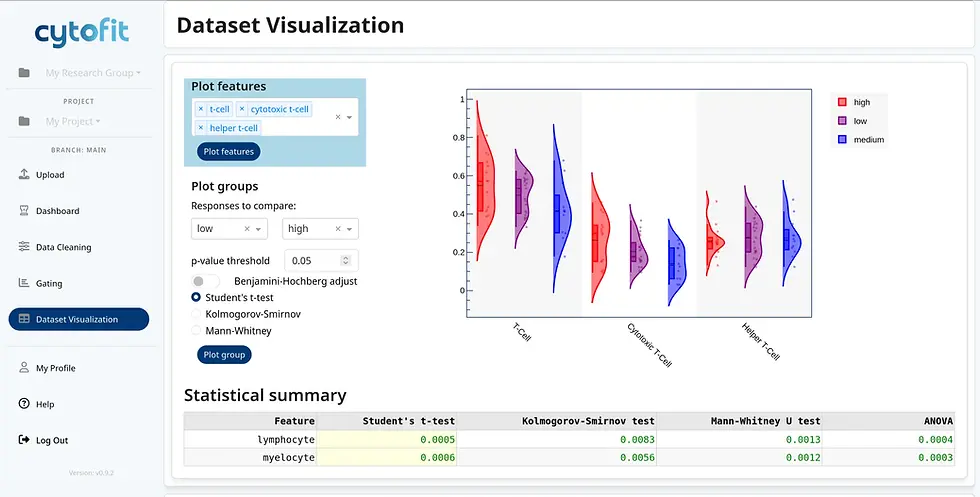
A clean, intuitive interface for managing projects, data uploads, and analysis pipelines
A frontend that supports data visualization, experimentation, and iteration
A cloud-based SaaS architecture that saves users time and hassle by eliminating local setup and maintenance
The result is a powerful, easy-to-use platform where large mass cytometry datasets can be preprocessed and statistical insights made ready for exploration within hours. Analyses that previously required weeks of manual filtering can now be handled smoothly in a single workday. This speedup makes advanced analysis results accessible earlier in research projects and clinical studies, when they can have the most impact.

Early access and rapid iteration
Cytofit was released to advanced pilot users in December 2025. The feedback provided by these users has been both encouraging and highly constructive, allowing us to prioritize the development of new features and performance improvements that are demanded by actual projects using mass cytometry.
Yesterday, we released a new version of Cytofit (0.9.1) that incorporates several improvements based directly on this early user feedback.
Continuous iteration, informed by real applications in cutting-edge research being carried out by our pilot users, remains central to how Cytofit is developed.
Looking ahead
Mass cytometry continues to evolve, both in scale and in scientific ambition. As datasets grow larger and research questions become more complex, the need for robust, transparent, and efficient analysis tools will only increase.
Cytofit is designed to grow with this field. Our focus remains on supporting advanced scientific and clinical users by combining solid statistical foundations, scalable infrastructure, and user-centered design.
If you would like to follow future Cytofit releases, technical updates, and research highlights, we invite you to subscribe to the Cytofit newsletter.
Cytofit is developed by Expert Analytics in Oslo, Norway.


Comments